The BBC News website is carrying a report about a new way of making lithium batteries which could massively speed up their charging time. It's unclear quite how long the charging would take with the new batteries: the BBC report talks about "20 seconds" in comparison to "6 minutes", so they clearly weren't testing a full capacity battery. However, if we scale that up, a 90 minute charge on current batteries would be reduced to 5 minutes with the new battery type.
Read on in the full article.
Will these batteries require new chargers (with higher amperage)? Thicker cables?
this needs to be a reality today... as do larger battery capacity in smaller batteries 😉
Rvirga, that's a very good question!
It's been a long time since I studied electronics, but common sense seems to dictate that higher current usually means thicker cables.
Or is there some important bit of physics missing in that assumption?
Y dont nokia use lithium-polymer batteries as ericssons. They ve much better capacity
rvirga wrote:Will these batteries require new chargers (with higher amperage)? Thicker cables?
It should be OK even if they do - as long as backward compatibility to the current chargers exists. Ideally even with current chargers these batteries should be able to charge faster - maybe not as fast as 5 mins, but definitely faster than 90.
This is even more important if Nokia or any other phone manufacturer is considering larger capacity batteries. If charging time does not improve, it will be a waste to have larger capacity batteries that need hours to recharge.
At the same time though, lots of people are shouting for USB charging, which is vastly slower even than current batteries can charge. Mostly due to the 500mA limit (max) for a powered USB port.
It can take hours to recharge a phone when it's hanging off my laptop's USB port - I don't know about anyone else, but my phones are very rarely plugged into anything for long.
Maybe if there were docking stations like we used to get, I'd get into the habit of dropping my phone in there when I'm at the desk but otherwise it's a hassle to find the cable and I only bother if I want to use mass storage or update firmware.
Nokia does have a nice looking adapter for their USB charging handsets though - you plug a normal charger into one end and it's got USB on the other, so it can still charge in the normal time. That's much better and gives you the flexibility to charge on USB when you're out and about and still have a decent charge time when you're at your home/work.
Y dont nokia use lithium-polymer batteries as ericssons. They ve much better capacity
They already do use lithium polymer, for example:
http://europe.nokia.com/A4400191
At the same time though, lots of people are shouting for USB charging, which is vastly slower even than current batteries can charge. Mostly due to the 500mA limit (max) for a powered USB port.
It's a fair point, but perhaps people just want the option of charging via USB if required, for example if they've got a data cable but no charger.
As you pointed out, if you have a charger with a USB-shaped connector on it, there's no current limit on the charging, which is the best of both worlds:
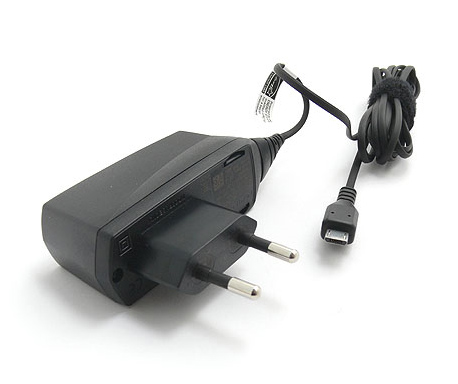
I know you all want to just put abigger charger and go on, but the most important part of the charger is in the phone. I had a Nokia 6120 classic wich wos a beast in ischarging batteries. I had 2 hours of talking time with both the original and the replacement battery... So what i did wos take a 800mA certified quickcharger with the bigger round conector and use a adapter conector for the small hole. As a result the power supply IC blew out... As you know phones just like computers need diferent voltages to supply procesors, memories, LED's and other internal circutries. They range from 0,5V to about 350V for camera phones with xenon flashes.
The bateries are charged trough that same power supply IC and this menas that it must handle 20% more power than the most powerful charger for the model can output, so it doesn't go puff.
What those new batteries will do is no diferent than the old ones. They will charge slowly with the old chargers and phone models and as quick as 5 mins in the new phones with powerful chargers.
The above means:
new battery + old phone = old phone + old batery + more capacity + less heating
new battery + new phone = quick charging phone + bulky charger
1000mA batery charges for 2h 10m at 500mA charging current(10 mins for losses in heat and resistance in all circuts)
1000mA fast charge batery charges for 6m 4s at 10000mA or 3m 2s at 20A
You can clearly see that the ampreage is not slightly but masively ramped up to the level car bateries are charging at. This means that the phones must be fited with a very powerful charging circutry wich will take more space and also dissapate alot more heat. (that's if the manifacturers dont get the bright idea to put all of the charging circutry in the charger itself.)
To sum up the above: phones will be more expencive both for the battery and the charger, car chargers will more ofen cause fuses in the car to blow up and the chargers will weight more than 400grams. On the bright side this kinds of bateries are more reliable, lighter and safer to use because of the lowered internal resistance causing lower heat generation in bateries.
Thanks for reading this. I hope i have made things a bit clearer than they were