
Picture walking along a sunny beach, throwing a big wet stick for a rather dumb Springer Spaniel by your side.... your mobile phone pings you with an incoming text. Checking it, you're horrified to read what's happening. "The Third Division Army has been ambushed approaching Gisa and is taking heavy casualties." Damn, you think, and you call up the troops to give them orders to strengthen the Third Division and prepare for counter-attack.
Except you're not a General in the US Army, but a gamer. A virtual, almost real-time, war game, has reached out from its server to touch you in the real world, pulling you back into the game. This was the tantalising idea placed in the heads of a number of journalists (including myself) at an N-Gage event in Barcelona back in October 2005.
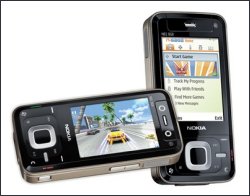 All well and good, but then the N-Gage (in that form) fizzled in public. Now, of course, it's here to ride again as a platform (which was also trailed in Barcelona). One of things I've always commented on, in regards to N-Gage, is that all the development has been done very much in the public eye - but like a good conjurer, nobody has actually spotted what's going on. Let's have a look at the trail of breadcrumbs.
Nokia have been heavily pushing their Ovi service, the idea of a connected, social sharing network of users. Part of that is the 'gaming' area of N-Gage, and it was this paradigm that Nokia's Anssi Vanjoki picked up on with his keynote at the San Francisco Game Developers Conference this week.
It managed to use all the regular Nokia buzz-words and phrases, "the fourth screen", "one billion consumers with Nokia devices", "powerful multimedia computers", etc. but, like any good Nokia presentation, the really new and intriguing stuff was hidden slap bang in the middle, with no massive emphasis.
"Contextual games."
Games that use everything in the phone, including, I suspect, the camera, the GPS, your mapping, multimedia, and even the built in ways to talk to the user - such as the SMS example from 2005 - could well be the ways where the N-Gage service can differentiate itself clearly in the mind of games players.
When the N-Gage was first launched, gaming was in a massive hardware war. Consoles were measured by the extra processor speed, screen resolution or memory. That's no longer the case. Nintendo managed to neuter that version of Murphy's law with the comparatively low spec Wii. The difference was that Nintendo changed the perception game from one of hardware, to one of software. Sound familiar?
Vanjoki hit many of the familiar Ovi features, but many were given a twist with hints of "this should happen in gaming". For example, his example of the Manhattan Story Mashup, a game that uses GPS, photography and messaging, and the implication that Ovi will handle all these features if the developers wanted to use them.
Jamil Moledina, Executive Director of the conference, laid it out in more black and white terms. "Giving developers the chance to create community experiences on any device is a key goal of the GDC overall, and so we are pleased to host Vanjoki's vision for empowering our attendees" - the attendees being the programmers, developers and buyers of the gaming world.
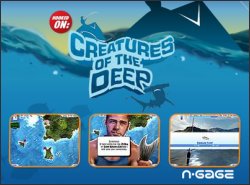 Now think about what Nokia have promised for their N-Gage platform - not from partners like Electronic Arts, or Gameloft, but from themselves. A lot of multi-player gaming. Games that run on multiple platforms (including smartphones and PCs), that allow massive multi-player experiences; the principle of high latency and players of vastly differing skill all having to be given a balanced gaming experience. All this is out there.
But into this you have to throw in all the new toys that a mobile should be using; local 'SMS' alerts from your in-game teams; the integration of contacts and messaging; a slow pollination of the game world into the real world; and then the real world being taken into the gaming world. If Ovi is Finnish for door, then N-Gage could be regarded as a key to allow two worlds to play together.
Of course, all this theory needs to be put into practice. Nokia have already had some major success in multi player gaming on mobile devices (witness Pathway to Glory), but N-Gage is no longer a separate part of Nokia, hidden away in the corner. It is an essential ingredient of Ovi; and the Ovi concept has been repeated over and over again to make sure that Nokia's vision of the paradigm shift that it represents is clear to as many people as possible. What better way to present context awareness both to the media and the consumer than through gaming?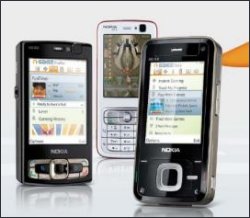 Look at the advantages the N-Gage platform has already - a distribution system that cuts out the expense of creating a physical product, shipping it around the world, and then having to pay a cut of the sale to a bricks and mortar retailer; a pre-installed base of over ten million devices (some three to four times larger than all the original N-Gage and N-Gage QD devices put together) at launch; and these media computer are always on - the expectation of the always connected [to the internet] smartphone could open up huge game play areas which have been previously unexplored.
Of course, all the other elements of Ovi can feed into N-Gage - while the idea of bringing the individual into the gaming world has gained acceptance through services like Xbox Live and the recent Sony Passport, Ovi will allow entire communities to interact, and potentially be pulled into games - with hooks into networks such as MySpace and Facebook on the horizon, the lines between the networks, services and software will start to blur for the benefit of the players. This already happens with World of Warcraft guilds prepping for raids in other networks (most notable are the instances of Second Life used to actually rehearse the raids).
Yes, Nokia have been telling us everything about where they are taking gaming. All you need to do is make a final leap of logic, take all the ideas, and throw them six months into the future:
I suspect we could be seeing all this come to fruition in the secretive (and much hyped) 'Project White Rock'.
More importantly, this unification will become a theme running through many N-gage titles in the future. If mobile gaming is truly different, as Nokia believes, it's going to build on all these speeches, presentations and theories. The games coming out over the next year are going to continue to push this idea of sharing, first in subtle ways, and then in more spectacular fashion. Nokia have taken on a big task, bigger than most were expecting. A new paradigm of gaming sums it up, but the challenge is immense. As is the reward.
-- Ewan Spence, Feb 2008