
DChoc already have their Solitaire Cafe on the N-Gage Platform (Tzer2 has reviewed it here, scoring it a 78), and with a large range of Java games in the Cafe series on their web site, it was only a matter of time before another one made it to the N-Gage.
The victor in the race was Sudoku, and that makes sense as it's probably the most well known genre after the card games. What we've got here is a well thought out version of sudoku, the number puzzle where you have to place the numbers 1 to 9 in a grid so that a number is repeated horizontally, vertically or in any of the nine boxes of nine squares on the grid. Wikipedia explains this a lot better than I can, so head over there if you are one of seven people who've never heard of it.
Just in case you are in that group, DChoc have provided a tutorial taking you through the basic principles of solving Sudoku puzzles – and as most of the generated puzzles in the title can be worked out using these tricks, that's a good thing.
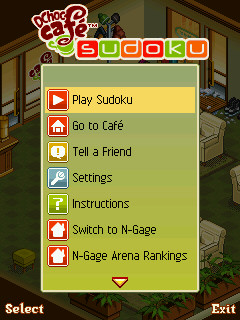
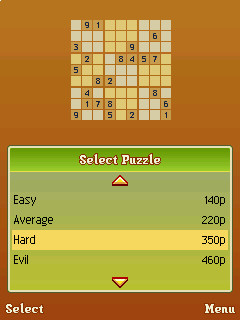
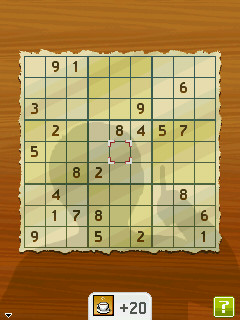
You can set the difficulty of each grid you play, and depending on the level you choose, you'll score a differing amount of points. These points are used to grant your little avatar new clothes, a bigger cafe (where you can invite people to join you, or visit their cafes). All of this is a similar model to all the other games in the DChoc Cafe stable – and in fact your avatar is consistent in this game world over the multiple titles.
But why have this ecosystem, and ignore the N-Gage Arena? One of the aims of the N-Gage platform was to grow a community around the games. While you still have the ability to score Arena points in Sudoku, these are unrelated to the points scored in the game. This just seems to negate the strategy of Nokia while helping grow the DChoc community. There will be a subset of that community who only play on the N-Gage, and of course with two titles available on the platform, this could grow, but it's a weird one.
Right then, extended user environments aside, how does Sudoku fare? Slightly worse than their Solitaire version, and this is mostly down to the graphics. While the idea of hand-drawn numbers in the grid looks great in the screenshots, it's not so good in practice. The fuzziness means the numbers just do not look clear at all, and when I scan over a grid in Sudoku looking for clues it does give me a touch of eye strain, even with my new glasses.
One of the biggest areas missing in this, and many mobile phone versions of Sudoku, is the ability to write down 'hints' in a box. This is where you write down a “1” if that number could be in that box. You can then work through all the possibilities, and gain more clues. This is something that usually isn't needed in the easier grids, but challenged Sudoku players pretty much rely on this skill to do more advanced solving.
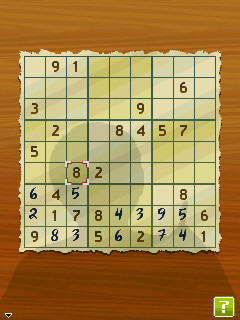
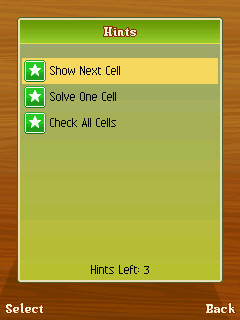
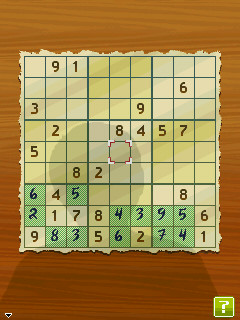
By not having this feature, Cafe Sudoku is cutting out a large group of players. This is probably a good strategy on the N-Gage. Aiming for hardcore, dedicated players could have over-complicated the interface to those just trying out the game, and there are more non-players than players out there. So on balance the needs of the many outweigh the - (no, I'm not going to quote "The Wrath of Khan" here [- err... you just did - Ed]). But there is a nice hints sytem, where you can ask a variety of questions to check or aid your progress.
With bright graphics, the cartoon avatars, and a modicum of community building, the DChoc team do know what they're doing – and bringing the games to the N-gage community firstly with Solitaire and now with Sudoku is a smart move.
It's also a smart move on Nokia's part, showing that they will happily take an independent publisher's gaming franchise, and not only bring it into their gaming platform, but allow the existing eco-system to grow. There are no real losers with DChoc Cafe's titles appearing on N-Gage, and while the games aim for a more mainstream appeal rather than going for hardcore players, they'll attract the wide audience these slick titles deserve.
AAN Score: 72%
-- Ewan Spence, Feb 2009.
POST-REVIEW UPDATE: Nokia have asked us to point out that there IS a feature in Cafe Sudoku for writing down candidate numbers, you have to hold down a number down while in the place you think it might be. AAN's reviewer missed this feature because for some reason it isn't mentioned in the game's interactive tutorial, which makes us wonder how many other people don't know about this feature. It's mentioned in the instructions, but who reads them when they've just played a lengthy step-by-step tutorial?