
There's a certain swashbuckling look to this game, from Electronic Arts. With a chisel-jawed hero and the 'exciting adventure' font on display (plus the all important sequel number), this has all the hallmarks and subtle signals of a Hollywood blockbuster from the 1950s. Which of course is an age ago in the motion picture, and is the perfect metaphor for Jewel Quest 3.


The underlying game mechanics is one of the oldest on portable computers, and made famous by Bejewelled. You have a grid of tiles (a mix of jewels, skulls and other Indiana Jones quest-like things) and you swap over two adjacent tiles to make a three or four in a row of identical titles; these will then disappear, gravity pulls down the tiles left behind, and the gaps get filled from the top.
This being a java application, there is a certain amount of “lowest common denominator” to the graphics and game-play, so the full width of the screen and vibrancy of colour palette that could be used has not been – the grid of tiles is left stranded in the middle of the screen, and with the 16:9 ratio screen on the X6 and other touch-enabled devices there's a feeling of a huge amount of wasted space.
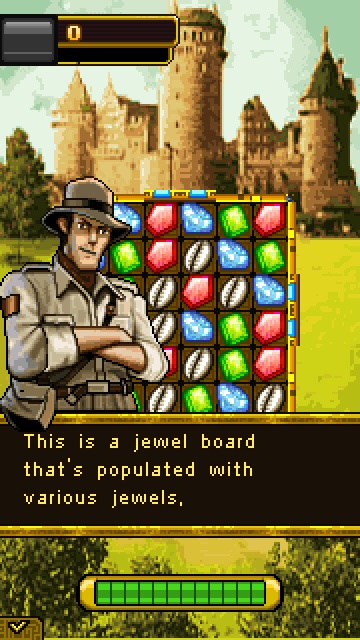
One thing I was worried about, namely how a game that relies on precise stylus control to move the tiny tiles around the screen would work with a great big finger on a capacitive screen, was something that I needn't have worried about. It's fine – whatever algorithm Nokia are using to pass (x,y) co-ordinates to applications picked up where I was aiming for with no worries. The only trick was that the game wanted the slide to the swapping tile to be just one tile width – I started by moving the width of the screen to register “left” when a smaller more subtle movement was needed.
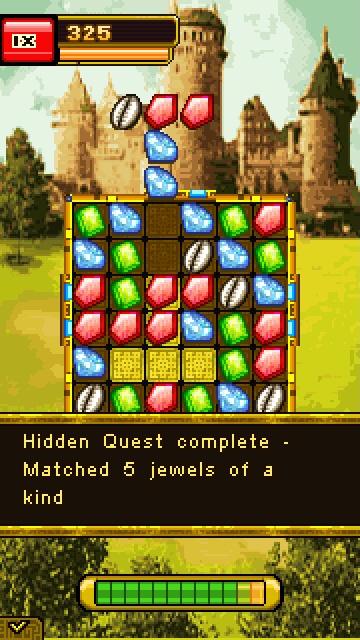
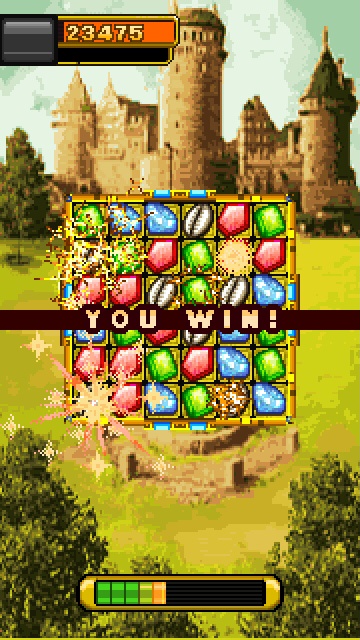
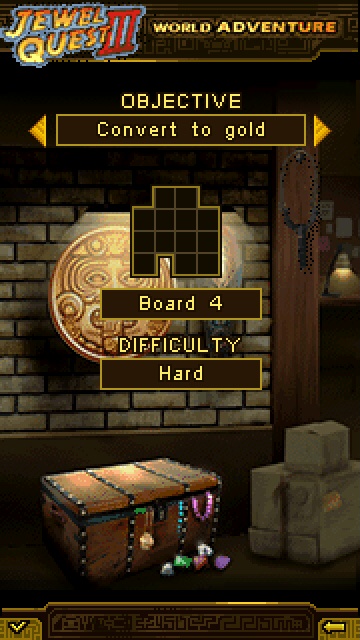
EA know that a Bejewelled game nowadays needs a lot more to it than the basic gameplay working – and they've added in a number of variations to the gameplay to tweak the game's goals. Now, as well as the endless “score as many points as you can” you have “score a set number of points before the timer runs out” and, my personal favourite, "Convert to Gold", which asks you to make as many 'three in a row's so that each square in the grid has been used at least once in a three or more in a row move – when tiles vanish, the square underneath turns gold, hence the Convert to Gold name.
But the core of this title is the “adventure” mode, and that ties in with our intrepid fedora-wearing hero. In the adventure, you're asked to discover the cure for some toxic spores that sprang up from a previous jewel board into your daughter's eyes (see it is a B-movie plot!). This loose plot holds together a large number of levels, using the different variants.
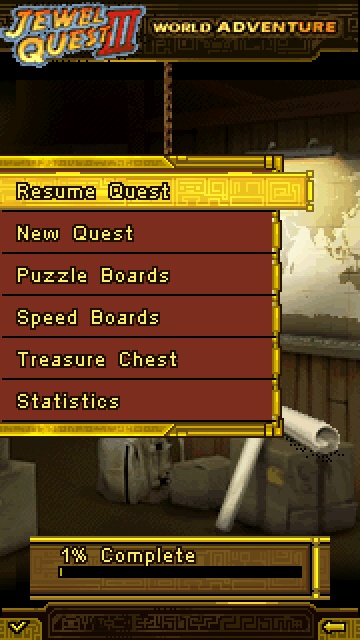
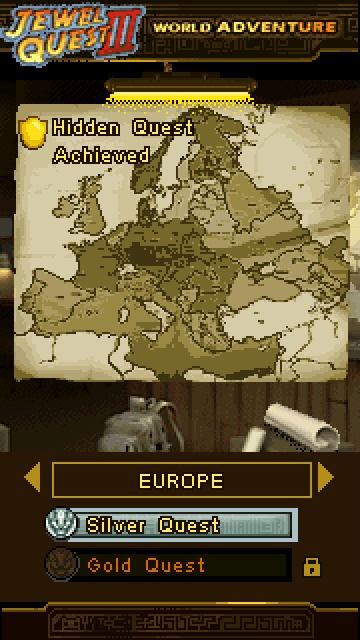
You can also tell you are on a quest as there is a picture of an English Castle in the background – and yes, this changes as you move through the levels. This structure does help the game have more life and longevity, it's far easier on a mobile game to work through a set path than simply go for high scores during every session.
Jewel Quest 3 hits all the clichés, and does everything you would expect a game like this to do. You even expect the designers to add some tweaks in to be a bit different to try and show you a new game. So, all in all, Jewel Quest 3 is not surprising. It does what it says on the tin, it's bigger and better than the game it was derived from (and bigger than the original Bejewelled), but like all sequels, there is a diminishing return.
If you don't have a Bejewelled clone on your phone, the this is worth a look, but if you've already got one of these titles, there's nothing essentially new here.
-- Ewan Spence, Jan 2010