
After Tetris took the world by storm, a million clones and almost-Tetris-like games came out. Some of them were quite good.
After Sudoku took the world by storm, a little less than a million clones came out, and some of them were also quite good. KenKen, created by Japanese mathematician Tetsuya Miyamoto in 2004, is one of the quite good clones.
Also played on a square grid, the goal of KenKen is to fill numbers into a grid. If it is a 5x5 grid, then you use the numbers 1 to 5, never repeating any number in a horizontal or vertical line... 6x6 grids would use the numbers 1-6, 9x9 using 1-9, and so on. There is a catch though (isn't there always). The grid is split into smaller irregularly shaped boxes, each one with a small number in it. The numbers that you write into each box must add up to this small target number.... assuming there is a + sign. If it's a minus, then you're subtracting, and so on for multiplication.


So if you have '8' as the target and you have three boxes to fill, you could write in 4, 3 and 1. If it 'turns a corner' then you could have 1, 6 and 1, as long as the 1's don't break the repetition rule above.
The addition of relatively basic arithmetic into the Sudoku grid provides something that's still as challenging, but just a touch different. For everyone who thought that Sudoku, by virtue of the numbers, involved some maths and was disappointed to find out it was just a 'placing things' game, KenKen is what you have been actually waiting for.
And to go with this delightful puzzle, Capcom have done a sterling job on the mobile version of the game, now available in the Ovi Store. There's a choice of three themes for the look of the game, including newspaper, japanese and notepad. Can I just say I love the notepad theme that goes with a style that mimics graph paper and grids drawn with a rather thick pencil. It works really well on the phone. It looks really nice, it suits the temperament of the game and although it is only a step away from the built in fonts and a regular grid, it makes the game feel that someone has spent time on the interface as well as the game.
They've certainly spent time on the puzzles, with a large database of built in puzzles, graded by difficulty. While my initial thought is to go for randomly generated puzzles, there are enough pre-built grids here to keep you more than satisfied for a few weeks. Not all the puzzles are available initially, you'll need to complete some puzzles at each level to unlock the full range of 50 puzzles per level (and five levels).
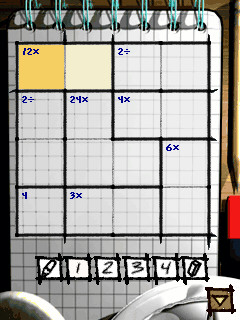
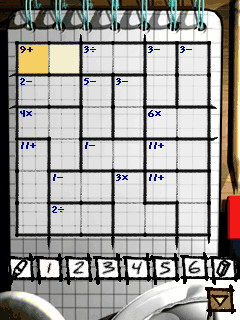
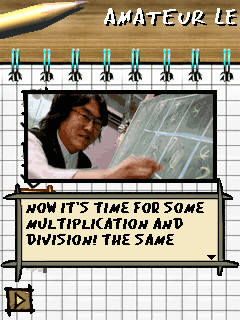
There is also a beginners tutorial mode for those people not familiar with KenKen (which is likely to the majority of players to be honest), which takes you through the rules and the interface; and an Academy mode which takes you through advanced techniques and tricks to solve harder levels.
KenKen doesn't do anything radically different from what you'd expect of a puzzle game on your phone. But it does the standard stuff really well – so well that it lifts up the title from being an average puzzler to something just a little bit special. Definitely recommended for puzzle fans.
--Ewan Spence, July 2009.