
There is only so much you can do to create a new type of game, and it's likely that when you release a puzzle game (like Rotoku) that people are going to see echoes of other titles in your design. That's definitely true here, and long term players will recognise both the number puzzle Sudoku and Nokia's Rotation game from their early pre-S60 handsets.
The goal is simple; you have a grid filled with numbers, and you have to manipulate them so that they create a solved Sudoku style grid, which is not the easiest of tasks when you can place numbers wherever you like, let alone with the twist Rotoku adds in; you have to move the numbers around the grid to get them in the right place. And here's where the puzzle aspect of the game comes to the fore.
You move the numbers around the grid by spinning round any 2x2 block of numbers (either clockwise or anticlockwise). You can do this as many times as you like, and you can spin any part of the grid like this. The catch is that by moving four numbers at any one time, you can't simply move a single number to where you want it go. Which is where the challenge comes in.
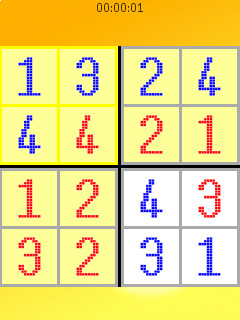
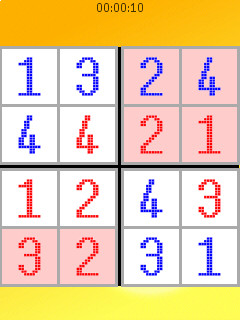
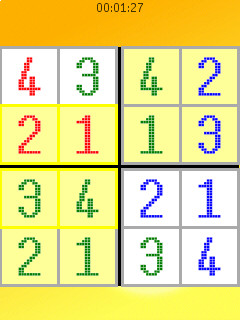
Winning is going to need planning, thought and patience. And, thanks to those relatively simple goals, Rotoku has all the elements for a good puzzle game on a mobile phone.
Of course, jumping straight to a full sized Sudoku grid of 9x9, filled with the numbers 1 to 9 (nine times each) is going to be a daunting prospect (but one that some will appreciate). Rotoku will start you off with an easier level made up of a 4x4 grid, with the numbers 1 to 4 in the grid. Easier, of course, being a relative term, but this is a good size, providing a challenge for beginners and leaving you time to work on moves and sequences that will be of benefit when you move up to larger grids, working towards the ultimate challenge of the 9x9.


Oh, and by making it a Sudoku grid, you need to solve that as well. Fiendish!
Rotoku remembers that it is being played on a computer, and makes good use of options in terms of presentation and game mechanics. It's happy to highlight when a number is in the correct place for an optimal solution to the grid being displayed to you, and also if a number is in the right region (the subdivision of the grid into smaller grids) and just needs spinning into the correct square.
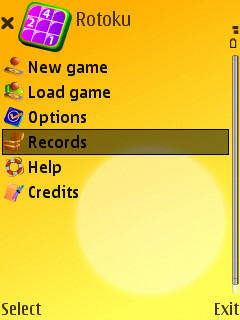
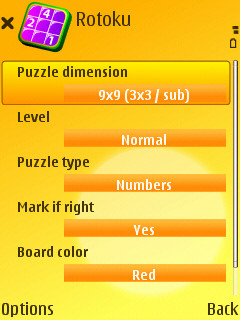
You can also change the grid colours to whatever works best for your eyes, which is a nice touch, and change from viewing numbers to either letters or symbols in the grid. Having played so much Sudoku, I found using anything other than numbers was quite difficult.
The presentation is good, and certainly a step up from a basic game, but it feels... functional. There has been work put in, and it does feel like more than “just enough” but there's a certain je ne sais quoi that makes me think that a bit more work needs doing on the menu system to make Rotoku a truly great puzzle game.
Rotoku is definitely for the hardcore fans, but it does provide a challenge that can be tailored from “difficult” to “mind blowingly impossible” and that's something I'm more than happy with. It's value for money, it can be played over and over again, and the satisfaction from solving a puzzle is a wonderful reward for the player who puts time into mastering the mechanics of the game.
-- Ewan Spence, July 2009.