
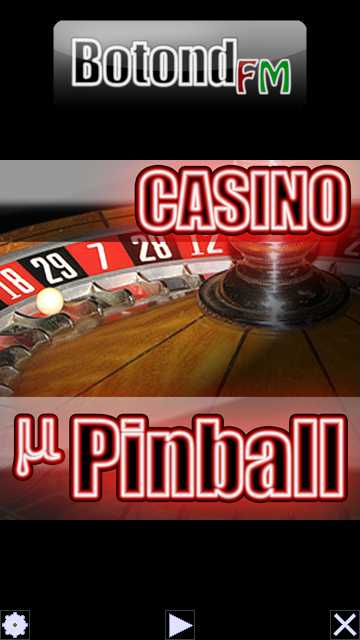

You may remember this game title from the world of S60 3rd Edition, a couple of years ago - here's my review at the time. Sparing you the pinball anecdotes this time round, this is the big-screened, fully optimised version for S60 5th Edition - the author has found ways of getting the tight pinball mechanics code to run smoothly even on the likes of the Nokia 5800 and 5530, though I also tested MicroPinball on the even-larger Samsung i8910 HD, as reported below.
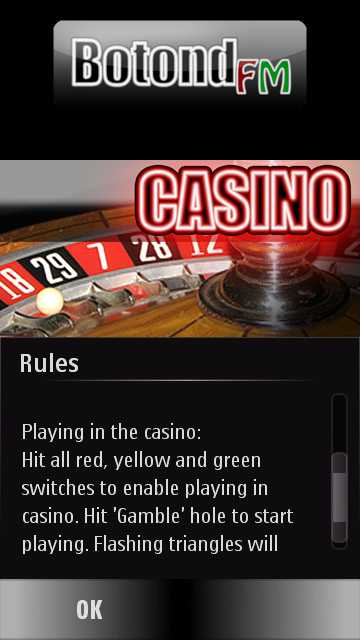
The idea, as with the excellent MicroPool from the same author, is to have a game that can be started and played quickly, to have as much simulation fun as possible without fuss, without lengthy loading screens and without complex story or 'career' structures. To that end, there's just the single table, themed after a casino (hence the title), with the usual targets and channels to aim at. One sequence of targets gets you an extra ball, for example, while a set of red, green and blue targets gets you into 'casino' mode, where you have to hit the targets that get randomly illuminated.
Within the caveat that there's just this one table, MicroPinball is really well done. Ball animation is easily fast enough to feel realistic, even on the resource-challenged Nokia N97, 5800 and 5530 (etc), while authentic pinball sound effects ring out on every contact, your phone's vibrator is pulsed on bumper activations and there's even a small degree of 'tilt' in that you can apparently knock the phone sideways to influence the ball's trajectory, using the built-in accelerometer. To be honest, I didn't notice the effect much and was too busy worrying about flipper positions and worrying about what to try for next.
You get three balls per game (plus any extra balls earned, if you're good enough) and then your cash score is totted up. Get a high score and you get a fanfare. And that's it. No more frills - but then this is as per author Gabor Fetter's design.
In terms of interface, flipper control is dead simple - tap anywhere on the left of the screen to activate the left flippers, tap on the right to activate the right ones. The clever bit is that Gabor has implemented multi-touch even on all the resistive-screened Nokia S60 phones - he does this by intelligently using the property of resistive screens whereby, if two points are pressed, the screen tech returns an average position. So if the game sees a touch point around the centre of the screen, it knows that both flippers are to be activated. Likewise, when you lift one of your fingers, the OS gives the game both the new resistive touch point and the fact that there has been a 'lift' from a previously touched point. Put this together with a few simple but clever algorithms and you've got convincing game multitouch - being able to manipulate both flippers utterly independently really adds to the realism.
Interestingly, on the capacitive-screened Samsung i8910 HD (and also on - presumably - the Nokia X6), the multitouch element doesn't work, which is odd considering that capacitive screens are associated with multi-touch from the likes of the Apple iPhone. Apparently it's because capacitive screens don't offer the same 'averaging' effect and because there's no official API to access capacitive multi-touch under Symbian. MicroPinball is still very playable on the i8910 HD and X6, you just have to make sure to operate the flippers by tapping at the right times, releasing one if you're intending to activate the other, etc. Another casualty on the i8910 is vibration when bumpers are activated, probably a device API issue but not a huge omission.
There's a lot of detail on the MicroPinball playing table and the larger the screen you've got the better. It'll play best of all on the N97, with a 3.5" screen plus flipper multitouch plus vibration, though the bright colours on the 3.7" OLED-screened i8910 HD are also pleasant to play with.
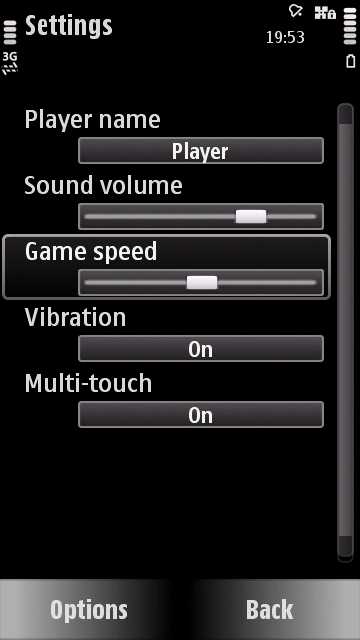
In terms of the pinball experience, the physics and believability are first class. About the only thing I found disappointing was the 'strength' of the flippers - I found their power rather feeble at times. The sound effects really add to the atmosphere - crank them up high in Settings. On the lower powered phones (like the 5800) there's a tiny delay between an on-screen action and the right sound effect, but it's not a showstopper.
A final comment has to address the price of MicroPinball Casino. At £4 it's fair value for a quality game, in terms of rewarding the programmer for his efforts, but in the context of an iPhone App Store world in mid 2010, it does look a little overpriced. Taking it to £2 would get it firmly into 'casual' game pricing, at which point people will buy even if they're not actually sure about the title. Just a thought. I do note that the iPhone version of the author's other main title, MicroPool, sells for $1.99 in the iPhone App Store....
Tech notes, minor compatibility quibbles and price aside, MicroPinball Casino is heartily recommended to get you through your next 5 minute wait for your wife at the supermarket checkouts, or to while away the time until your train is due at the station.
Steve Litchfield, AAS, 8 Sept 2010